Skip to content
FactorizerContact

Solutions and products

Systems built for the environment they work in

We deliver four things: electric and autonomous industrial vehicles, robotic and automation cells, Cluster ERP, and contract steel fabrication. Each is designed for a defined operating environment rather than sold as a standard unit.

Product and solution lines
4
Sectors served
6
Standards held by the production environment
5

Hardware and software

What we deliver.

Vehicles

Electric and autonomous industrial vehicles

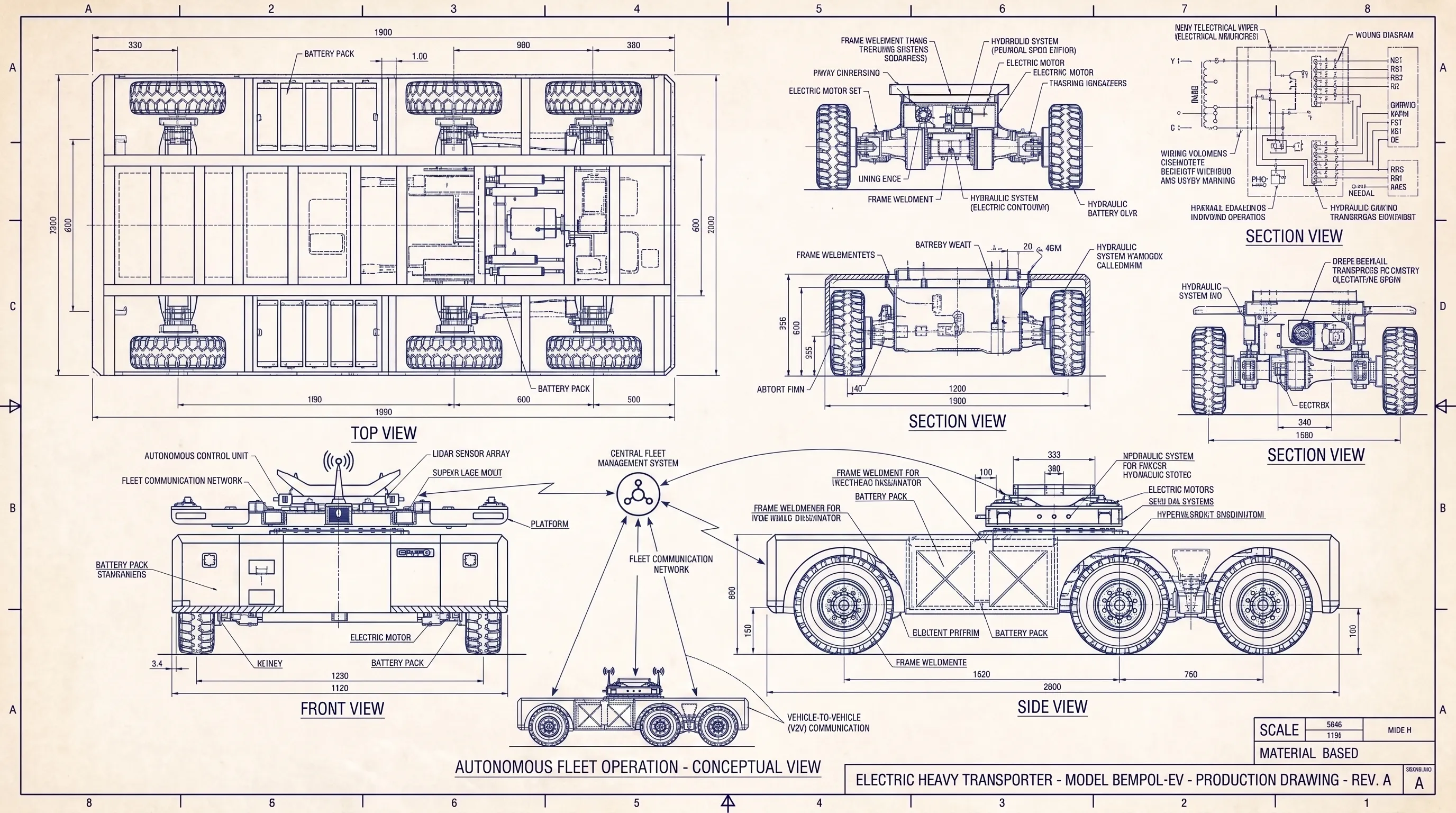
These vehicles are our own technology. The platform, the electric powertrain on UK-made smart motors, the autonomous and remote controlled operation and the operator interface are designed and built by us as one system. They are not bought in and rebadged, and we are not converting a machine somebody else built.

The platform is sector-agnostic, and what it is on any given day is decided by what is fitted to the deck. In aircraft assembly that means a fuselage can stay on the same platform from the start of production to the end of it, rather than being lifted off and set down again between stations.

  • Carries a workpiece through production, not just between buildings
  • Precision positioning between stations
  • Fully electric, on UK-made smart motors, with regenerative braking
  • Heavy payload, carried low and flat on the deck
  • Attachment-defined: the deck decides what the machine is
  • Broken ground, uneven surfaces and gradients
  • Works alone, in a pair, or as a coordinated fleet
  • Autonomous or remote controlled operation
  • After-sales service, spares and remote diagnostics for the life of the machine

Who it suits

Operators whose work is repetitive, continuous or hazardous enough that removing the person from the cab changes how the whole operation is organised.

Samples of our solutions

01 / 07

One platform, driving a circuit

There is nothing to steer. Every change of direction is a turn about its own centre, one side of wheels driven against the other, then straight on down the new axis.

Cells

Robotic and automation cells

Turnkey cells for welding, palletising, machine tending and comparable applications. Each cell is simulated and validated before manufacture, then built, integrated and commissioned by the same team.

Robot choice follows the application rather than the other way round, so the cell is specified before a brand is.

  • Welding cells and welding cabinets
  • Palletising and depalletising
  • Machine tending, cobot applications and deburring
  • Gripping and EOAT systems matched to the part

Who it suits

Manufacturers with a process that is well understood but hard to staff consistently, where the constraint is throughput or repeatability rather than machine capability.

Robot platforms we integrate

  • Fanuc
  • Yaskawa
  • ABB
  • KUKA
  • Nachi

Gripping and end-of-arm tooling

  • Piab
  • Schmalz
  • Schunk
  • Zimmer
  • PHD

The cell, running

Approach

01 / 07

InfeedOutfeed pallet

Palletising, layer by layer

Boxes come off the infeed and are stacked to a set pattern until the pallet is full, and then it leaves. The reach, the clearances and the order the layers are built in are settled in simulation, before the cell is built.

Fabrication

Contract steel fabrication

We manufacture and deliver fabricated steel parts to order, in the same production environment and to the same standards as the systems we build for ourselves.

  • Fabricated and welded steel parts made to drawing
  • Structural fabrication to EN 1090-2 EXC3
  • Welding to EN ISO 3834-2
  • Delivered as finished parts, not as a system

Who it suits

Work that has to be made to a standard the customer can evidence, where the fabrication itself is the deliverable.

Enterprise software for project work

Cluster ERP

Cluster ERP is our own modular enterprise resource planning software, built for companies whose work is driven by projects and production rather than by stock movements alone. It covers the ground a production business needs covered, with the eBOM, MRP and MES at the centre of it, and because we build it ourselves it can be shaped around how a business actually runs.

What modular means in practice

A project- and production-driven company rarely needs every part of an ERP on day one, and rarely needs them in the same order. Modular means the system is adopted in stages: start with the area causing the most pain, run it properly, then extend into the next area without replacing what is already working.

Modules share one data foundation, so extending the system adds capability rather than adding another set of records to reconcile.

Module areas

  • eBOM: the engineering bill of materials everything else is built from
  • Project and works order management
  • MRP: material requirements and production planning
  • MES: shop floor execution and tracking
  • Procurement, inventory and materials
  • Quality, traceability and documentation
  • Costing, commercial and reporting

Who it suits

Engineering and manufacturing businesses running to order, where jobs are individually costed and generic stock-led ERP forces the work into the wrong shape.

Modular adoption, area by area

One shared data foundation across modules

Built for project- and production-driven operations

Developed and supported in-house

Ask about Cluster ERP

Delivery

From requirement to running fleet.

Every programme follows the same route, whatever the sector. The stages below are carried by one organisation, so the people who set the requirement are the people answering for it at commissioning.

  1. 01

    Requirements

    We start in the operating environment, not in the specification document. The duty, the constraints, the safety picture and the people involved are established before any design decision is fixed.

  2. 02

    Design and simulation

    Concept and detailed design are developed and then validated digitally. Cells and processes are simulated so reach, cycle, layout and collision questions are resolved before steel is cut.

  3. 03

    Manufacture and integration

    Systems are manufactured in a production environment certified to ISO 9001:2015, ISO 14001:2015, ISO 45001:2018, EN ISO 3834-2 and EN 1090-2 EXC3. Mechanical build, robotics, controls and interfaces are integrated as one system.

  4. 04

    Commissioning and operation

    We commission on site and hand over a system proven in its real environment. From that point it is backed by long-term service, maintenance and operational support.

Next step

Tell us what the environment demands.

Whether it starts as a vehicle, a cell or a software problem, the first question is the same: what does the work actually require. Send us the operational picture and we will come back with what it takes to build and run it.

Discuss a programme